
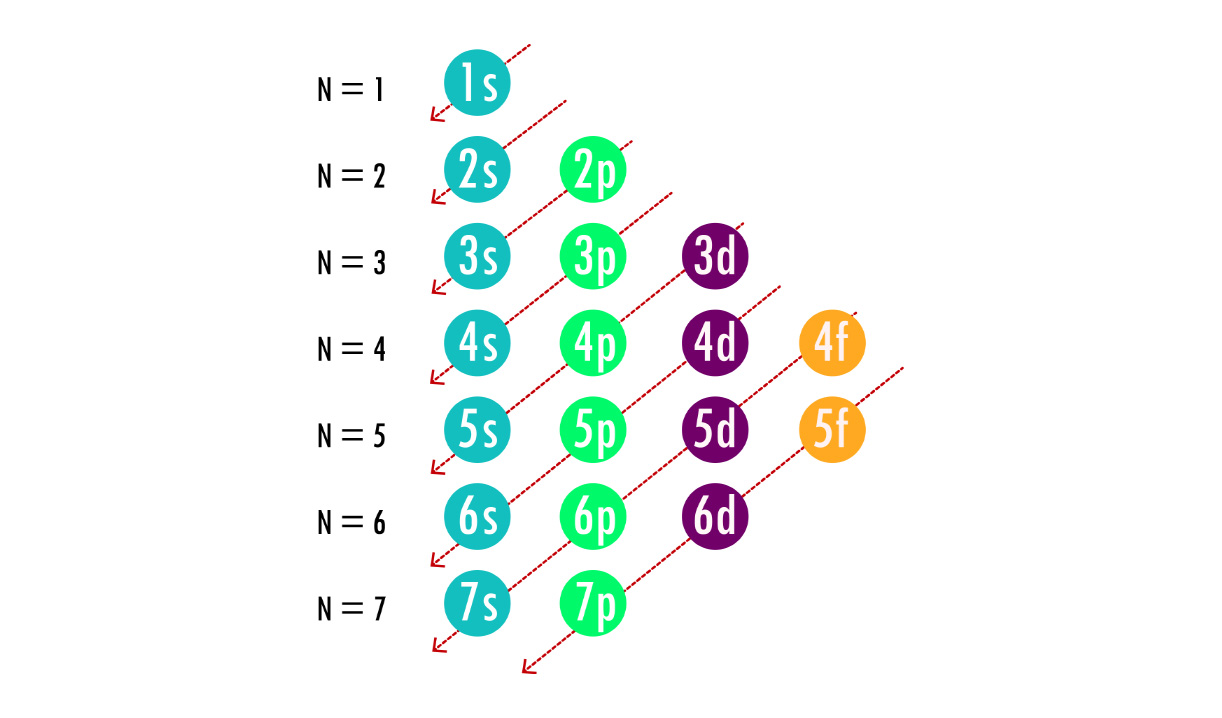
Aufbau Principle: Electron Filling Order

Aufbau Principle: Electron Filling Order

This image is a detailed visual representation of the Aufbau Principle, a foundational concept in chemistry used to determine the ground-state electron configuration of an atom. The principle states that electrons first occupy the lowest-energy orbitals available before filling higher-energy ones.

The diagram organizes the principal quantum numbers (N=1 to N=7) vertically and the different orbital types (s, p, d, and f) horizontally. The diagonal, dashed red arrows indicate the correct sequence of filling, reflecting the relative energy levels of the orbitals.

How to Use the Diagram:

  1. Start at the top: Begin with the 1s orbital (the lowest energy level).
  2. Follow the arrows: Proceed down the first red arrow, then move to the beginning of the next arrow, and continue the sequence.
  3. The filling order is: 1s → 2s → 2p → 3s → 3p → 4s → 3d → 4p → 5s, and so on.

The diagram clearly shows the key observation that orbital energies can overlap; for example, the $4s$ orbital fills before the 3d orbital, and the 5s fills before the 4d. This order is crucial for understanding the chemical properties and reactivity of elements as organized in the periodic table.

All content on this page is licensed under the Creative Commons Attribution 4.0 International License (CC BY 4.0). You are free to use, share, and adapt this content for both commercial and non-commercial purposes. Attribution is appreciated when sharing or adapting this content.
Aufbau Principle: Electron Filling Order by Learnbin Lab, licensed under CC BY 4.0. Accessed: June 18, 2026.
Copy

References

Learnbin (2025). Electron Configuration. Retrieved October 18, 2025, from https://learnbin.net/electron-configuration/.

Disclaimer

All content on Learnbin Lab is published for educational and informational purposes. While we strive for accuracy, we cannot guarantee completeness or correctness, and users should verify any chemical, safety, or experimental information before use. 

All experiments or chemical handling are done at your own risk, and Learnbin Lab is not responsible for any injury, damage, or loss. External links are included for reference only and do not imply endorsement.

Always follow safety instructions provided by qualified instructors when performing laboratory work or experiments.
Learnbin Lab - © 2026 learnbin.net. All rights reserved.